The Two-Column Choice: What You Gain and What You Give Up
Use a two-column choice to compare everyday options, make each trade-off visible and choose the path that fits your priorities without chasing a perfect answer.
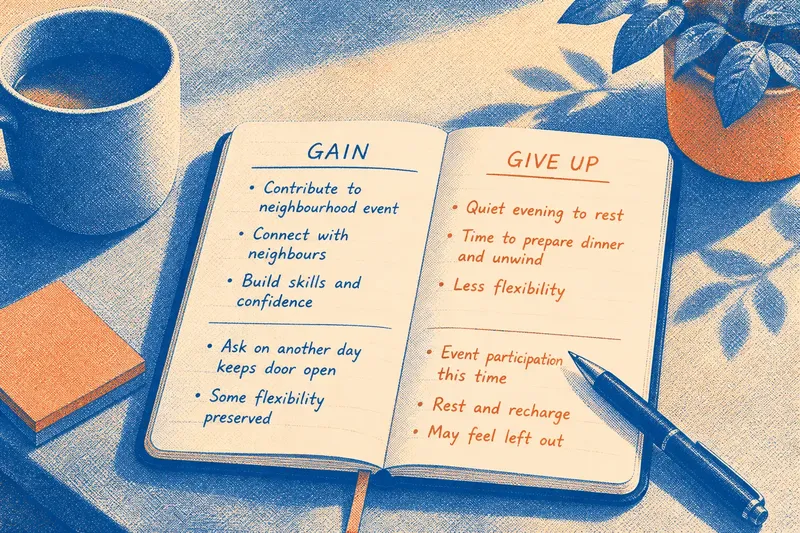
A two-column choice makes an everyday decision easier to see: write down what you gain and what you give up with each option. This helps when both choices have a genuine appeal and neither is free of cost.
You might be deciding whether to join a friend’s weekend trip or stay home, take on an extra project or keep your current workload, or buy a convenient item rather than make do. The aim is not to predict every consequence; it is to understand what each option asks you to accept.
Describe each option as an action
Start with two specific choices, not one appealing option and a vague alternative. “Go to the family lunch and leave after the main meal” is easier to compare with “stay home and call later” than with “do something else”. If you have three viable options, compare them in separate pairs or use three columns, keeping each description equally concrete.
Keep the decision within your control. You can choose whether to attend an event, but you cannot decide how everyone else will react. Separate the action you can take from the response you can only anticipate.
Say you have been invited to help organise a neighbourhood event on the same evening you planned to rest. Your choices could be to take a defined task, decline this time, or ask whether help is needed on another day. Each gives you a clear action to weigh.
Record concrete gains and costs
Draw a line down a page and label the columns Gain and Give up. For each option, list likely benefits and the costs you would willingly accept. Include practical demands, emotional effects and what the choice may make harder, not just what looks good on paper.
For the neighbourhood event, taking a defined task might bring connection and a useful contribution, while giving up a quiet evening and some flexibility. Declining could protect rest and leave room for an existing commitment, while giving up the chance to participate. Asking about another day could preserve some choice but require a further conversation.
Use plain, observable language. “Less time to prepare dinner” is more useful than “bad balance”; “I may feel left out” is more honest than pretending declining has no emotional cost. If a cost depends on someone else’s response, mark it as uncertain.
Keep each entry short enough to scan. Include a consequence in both columns only when the option genuinely has two different effects.
Choose a comparison method that fits
You do not need to weigh every item equally. Pick the comparison that best fits the decision, then apply it consistently to each option.
- Compare with a priority. Check which option better protects what matters most here. If one clearly does, choose it; if not, compare acceptability or reversibility instead.
- Compare by acceptability. Check which costs you can live with and which would leave you resentful or stretched. If one cost feels unacceptable, choose the other option or revise the choices; if both are acceptable, use another comparison.
- Compare by reversibility. Check which option leaves room to change course. If one is easier to adjust, consider it when you need a trial choice; if neither is readily reversible, seek the information or advice the decision requires before committing.
These are different lenses, not scores to add up. If one option looks best under one method and another under a different method, decide which question matters most in this situation.
What should you do when the trade-offs remain unclear?
What if both options seem equally good?
Look at the costs you would actually have to carry rather than searching for a hidden perfect option. If the trade-offs still feel balanced, choose the option that is easier to reverse or set a time to decide instead of reopening the comparison repeatedly.
How should you handle uncertain consequences?
Write what you know separately from what you are predicting. If a low-risk conversation could clarify an important detail, ask before deciding; otherwise, treat the uncertain result as a possibility, not a promise.
Should you count every small advantage?
No. Include details that could reasonably affect your choice, and leave out points that simply repeat another entry. If the list is hard to scan, remove duplicates and keep the main trade-offs.
What if someone else dislikes your decision?
Include the possibility of their disappointment if it matters to you, but do not treat it as proof that your choice is wrong. Decide what you can communicate clearly, while recognising that their response remains theirs to manage.
Use the comparison to make a decision
Once the columns are complete, say your choice aloud in one sentence: “I’m choosing this because I’m willing to give up that.” If the sentence feels accurate, the decision may be clear enough. If it does not, check whether you have missed a meaningful cost, described an option too vaguely or confused a prediction with a fact.
Imagine you planned to rest on the evening of the neighbourhood event and were offered a specific organising task. You write down that accepting could let you contribute and connect with neighbours, but would take your quiet evening; declining protects your rest but means missing the event. You decide that rest matters more this time, so you decline and ask whether help is needed another day. The resulting choice protects the evening while leaving open a way to contribute later.
For a small, reversible choice, make the call and notice what you learn from living with it. If a decision has serious financial, legal, health or safety consequences, use the comparison to clarify your concerns, but seek advice from a suitably qualified professional where it matters.
Keep the two-column choice for moments when you are stuck between plausible options, not as paperwork for every preference. A clear two-column choice can show what you are choosing to value and what you are prepared to set aside, even when certainty is out of reach.