The Objects We Keep in View
Choosing which personal objects stay visible can make a room express a present-day priority while keeping shelves calm, useful and easy to live with.
The objects you keep in view can make a room express what matters to you now, but too many can make that message hard to read. Choosing what stays visible is less about creating a display than deciding which things deserve a place in your daily line of sight.
A room can hold family history, unfinished interests, useful tools and gifts without showing all of them at once. When visible objects compete for attention, the problem is often not that you own too much; it is that the room has not been edited for the life you are living today.
When every meaningful object seems to deserve a place
The first difficulty is treating visibility as a measure of affection. A handmade bowl from a friend, a travel souvenir and a child’s drawing can all matter, yet that does not mean they must all occupy the same shelf.
Try separating the question of meaning from the question of placement. Keep the object if you want it, then decide whether it should be visible here, stored safely, used elsewhere or passed on. A memory does not become less important simply because the object is put away.
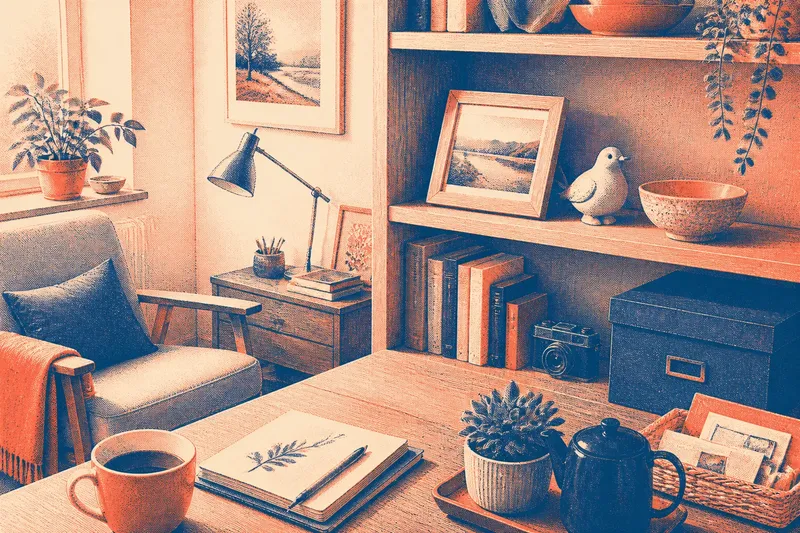
Say you have a small bookcase holding a framed photograph, a ceramic bird, a shell, a souvenir mug and several cards. If the photograph is the one you want to notice each morning, move the other keepsakes to a memory box or another room and give the photograph breathing room. The observable result should be a clearer view of the object you chose, not a verdict on the value of the others.
Start with one surface and choose a single object to anchor it. Put the rest somewhere temporary while you decide what belongs with it.
When the display says more about the past than the present
Objects can remain in view because they once represented a priority, even after your attention has moved elsewhere. An instrument bought for a former hobby, a stack of specialist books or a sports trophy may begin to feel like a public promise to keep being the person you were when you acquired it.
That discomfort can come from confusing an object’s story with a current obligation. You can value the effort or curiosity it represents without displaying it as a pledge to resume. Consider whether the object still has a role in your daily life, or whether a photograph, a smaller keepsake or a place in storage would honour its history with less pressure.
For an item tied to an interest you might return to, avoid making a rushed decision during a difficult week. Put it somewhere you can retrieve it easily, then notice whether you miss seeing it or feel relief at having the space back. The point is not to prove that the interest has ended; it is to make the room fit your present routines.
When personal objects start to look like a shop display
A collection can lose its personal character when every item is arranged to look polished or coordinated. This often happens when the room is being judged from the doorway rather than used from the chair, desk or kitchen table where you spend time.
Keep the arrangement connected to ordinary use. A favourite mug can sit near the kettle, a sketchbook can remain on the desk and a small plant can occupy a bright windowsill. These objects express a priority through where they support daily life, rather than through a staged cluster.
If you want a more deliberate display, give it a boundary: one shelf, one tray or one section of a mantel. Keep the chosen items there and let the surrounding surfaces do other jobs. A defined area prevents personal expression from spreading until every available ledge becomes an exhibit.
Look at the room from the place where you usually sit, not only from the entrance. If the objects you care about disappear among unrelated items, remove visual competitors before adding anything new.
When a crowded surface keeps returning
A shelf can look edited on the day you clear it and become crowded again by the end of the week. The usual cause is that it is serving as a landing place for parcels, keys, papers or objects that have no assigned home.
Work out what the surface is doing before choosing what it should show. If you need a place for keys, provide a small bowl by the door; if post gathers there, sort it in a separate spot. Once the practical traffic has somewhere to go, you can choose what deserves the remaining visible space.
Use a simple return rule for the display itself: when a new object arrives, decide what it replaces or where it belongs before setting it down. This need not apply to every possession in the home. It is a way to protect the particular surface you have chosen to keep intentional.
When gifts make choosing feel unkind
A gift can carry the giver’s care, and putting it away may feel like rejecting that care. The pressure often comes from imagining that the giver is continually checking whether the object is on show, even when the gift was offered for your enjoyment.
Separate gratitude from permanent display. You can appreciate a present, use it when it suits you and store it with care when it does not fit the room. If the giver visits often and the subject matters, a warm, straightforward explanation is kinder than keeping an object visible while quietly resenting the space it takes.
For gifts with practical use, let use decide the location: a serving dish belongs where you can reach it, while a warm scarf belongs with clothing rather than on a decorative hook. A gift need not become a room’s main feature to remain part of your life.
When you are unsure what should stay visible
Use these questions to make the choice without turning it into a full-room makeover.
How do I choose which personal objects to display?
Pick the objects you want to encounter in the room’s ordinary use, then give each enough space to be noticed. If an item matters but does not suit that location, keep it elsewhere rather than forcing it into the display.
How many objects should stay on one shelf?
There is no useful fixed count because shelf size, object scale and daily use differ. Stop adding when the objects begin to obscure one another or make the shelf harder to clean and use.
What can I do with meaningful objects I put away?
Store them in a labelled box, a drawer or a place suited to their material, and keep the location easy to find. Rotate a few items when you want a change, rather than leaving every keepsake out at once.
How can I keep a display from feeling staged?
Include objects that belong to the room’s real routines, and avoid arranging everything solely for a photograph or visitor. A useful object can still be beautiful; it does not need to look untouched to be worth keeping in view.
When the room still does not feel like yours
Sometimes the chosen objects are right, but their placement follows someone else’s habits: a shared household arrangement, an old decorating decision or the assumption that a particular surface must remain clear. If the room is shared, agree on which areas are common and which can carry one person’s preferences.
Where you have control, test a small change before moving furniture or buying storage. Shift one object to a spot where you naturally look, then live with the arrangement through ordinary mornings and evenings. If it gets in the way, return it and try another location; the room should support your attention, not demand upkeep for its own sake.
Choosing what remains visible is a modest form of self-expression: it lets a current priority have a place without asking the room to catalogue your whole life. The objects you keep in view can change as your days change, and the most useful display may be the one that leaves enough space to notice them.