The Difference Between a Value and a Goal
The difference between a value and a goal helps you adapt a changed plan, choose a practical next action and stay connected to what matters.

The difference between a value and a goal becomes clear when a plan changes: the goal may no longer be possible, but the value can still guide your next choice. A value such as curiosity or care is an ongoing direction; a goal such as completing a course or arranging a visit is a particular result.
Confusing the two can make a worthwhile commitment feel like a failure when circumstances shift. Separate them by naming what matters, identifying the outcome you hoped for and choosing an action that still fits.
Start with what you want your choices to express
Think of a recent moment when you felt quietly satisfied with how you acted. It need not have been a major achievement: perhaps you listened without interrupting, asked a question instead of pretending to know, or declined an invitation you could not manage.
Write down what mattered in that moment. “I want to be a good friend” might point towards loyalty, honesty or attentiveness. The first phrase describes an identity; the others are possible directions for choices. Choose words that help you decide what to do, rather than judge your whole character.
Keep the list short enough to use. If two words seem similar, ask what each would lead you to do differently in the same situation. If you cannot tell, choose the one that feels clearer for now.
Tell a value from an outcome
Ask whether each candidate can guide you in more than one situation. Learning, for example, can shape how you approach a conversation, a hobby or a mistake. Finishing a particular book has a defined endpoint: when it is done, you can choose another goal or leave it behind.
A goal is not less meaningful because it ends. It makes a broad intention concrete, giving you something specific to work towards. Values point; goals mark a destination.
Try completing two sentences: “I want to act with…” and “I want to…” The first invites a continuing quality of action; the second usually names an outcome. If the second describes a result, ask what value made that result matter in the first place.
Choose a goal that gives the value a place to act
Consider where a value could matter in your actual week. Rather than choosing a goal because it sounds impressive or earns recognition, ask what result would give the value a useful, visible expression in your current circumstances.
Say you value connection and hoped to organise a large family gathering, but several relatives cannot attend. The gathering is the goal; connection is the value. You could arrange a smaller meal with those who are free or set up a call with someone who cannot come. The formats differ, but each can express the same direction.
Make the chosen goal specific enough to act on and proportionate to your time and energy. “Be more connected” does not tell you what to do today. “Message my cousin to ask when she is free to talk” gives the value a practical opening without turning it into a test of your worth.
Check whether the goal still serves the value
Plans can continue long after their original purpose has changed. Before putting more effort into a goal, ask what it is meant to express and whether that connection still feels real. If the answer is unclear, the goal may have become an obligation, a habit or an old picture of success.
Imagine you set a goal to attend a professional event because you value learning. On the day, the sessions you wanted to hear have been cancelled and you are exhausted. You could leave and choose another way to learn later, or stay briefly and speak with someone about an interesting subject. Either choice may fit; ask whether the action still serves the value.
Changing a goal is not the same as abandoning a value. You may need to pause, alter the format or find another opportunity. A value can inform your choice without requiring constant activity.
Use a clear sequence to choose your next action
When you are unsure what to do, write your answers plainly. This sequence helps separate the outcome you wanted from the direction you can still express:
- Name the situation. Describe the decision or plan in one sentence, such as “I have not replied to an invitation.”
- Identify the value at stake. Choose the direction you want to express, such as consideration, honesty or rest.
- Separate result from direction. The result might be attending the event; the direction might be staying connected or respecting your limits.
- List possible actions. Include options that do not achieve the original result, such as suggesting another time or sending a warm reply.
- Choose a manageable action. Select one that fits the value and your actual capacity, then decide when to do it.
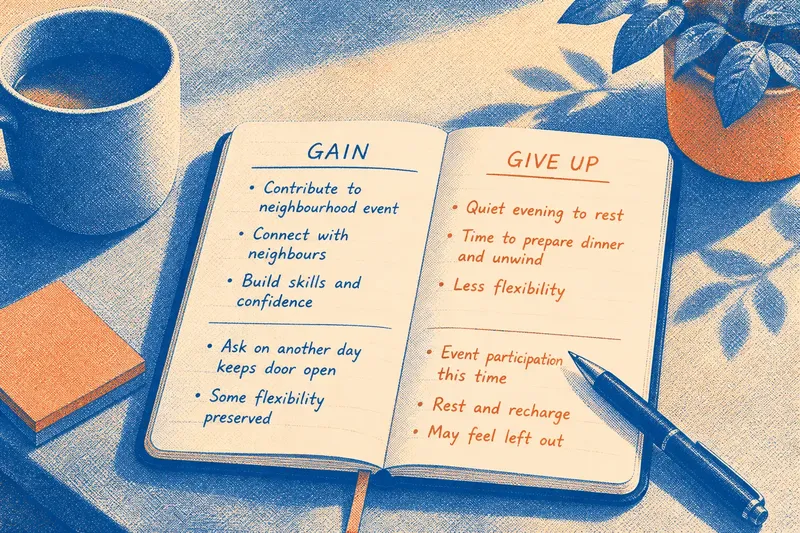
For instance, imagine you have not replied to a friend’s invitation because you are tired, but you value both honesty and connection. Write down the situation, then name those two values. Separate attending the dinner from staying connected, and consider replying honestly that you cannot come while suggesting a quieter time to meet. If that message fits your capacity, send it; the observable result is a clear answer and an invitation to keep in touch, even though you do not attend.
This sequence is for clarifying an ordinary personal choice, not finding a perfect answer. Some decisions involve competing values: honesty might favour saying what you think, while kindness might shape how and when you say it. Look for an action that gives both room, or acknowledge which needs more attention in that situation.
Keep the direction flexible and the action concrete
A value is easier to live by when it can adapt to changing conditions. If you value generosity, you do not have to say yes to every request; a thoughtful refusal may protect your ability to help later. If you value creativity, a small sketch or playful question can express it when a larger project is not feasible.
Make your next action observable. “Be more patient” is a direction, not an action. “Let my colleague finish before I answer” gives patience a behaviour you can recognise, without pretending one moment defines you.
When a goal becomes difficult, ask whether the problem is a genuine obstacle, an unrealistic plan or a value that no longer feels like yours. Adjust the goal if needed; do not keep pursuing it merely because you once wrote it down.
What should you ask about values and goals?
Can a value ever be completed?
A value is an ongoing direction, so it does not have a finish line in the same way a goal does. You can act with curiosity in one moment and make room for it again in another, without declaring curiosity complete.
Can one goal express more than one value?
Yes. A shared meal might express connection, hospitality and care. If those values pull you towards different choices, name the tension rather than assuming the goal must satisfy them all equally.
What if you cannot name the value behind a goal?
Ask what would make the outcome matter to you, and keep asking until you reach a direction that could guide several kinds of action. If no answer comes, set the goal aside briefly and consider whether it reflects an expectation you have not chosen for yourself.
How do you choose when your values conflict?
Be specific about the situation and the people affected, then consider which action respects the most important concern without ignoring the others. If the decision carries serious consequences, take time to think it through and seek advice from someone you trust or a qualified professional where appropriate.
Use the distinction without turning it into a scorecard
Values and goals offer different kinds of guidance. A goal can organise effort around a desired outcome; a value can help you decide whether that outcome, and the route towards it, still suits you. Neither needs to prove that you are a particular kind of person.
For a useful next step today, choose one goal you are carrying and write the value it is meant to serve beside it. Then choose one action that expresses that value, whether or not it completes the original plan. The difference between a value and a goal gives you room to change the destination while keeping direction in your next choice.