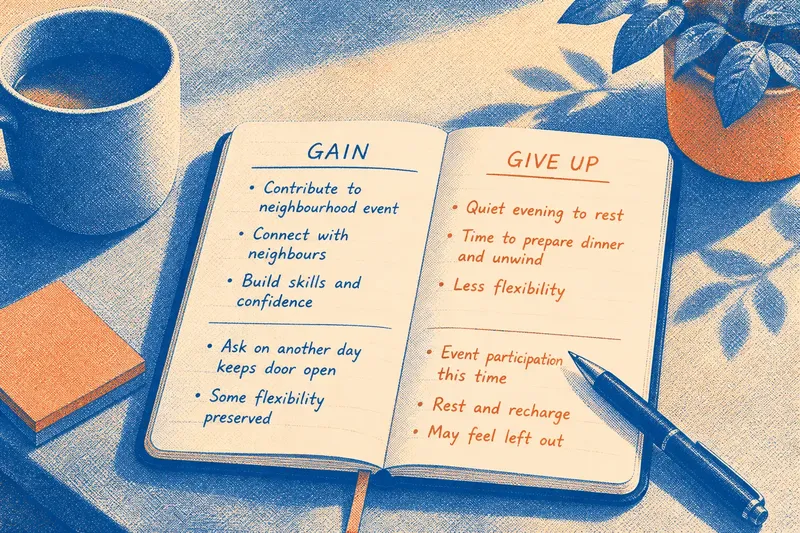
A Sunday Plan with One Unscheduled Hour
A Sunday plan with one unscheduled hour gives your week room to absorb changes without turning every open moment into another task.

A Sunday plan with one unscheduled hour gives your week room to absorb a change without asking you to reorganise every commitment. Mark a genuine hour as open, then resist assigning it a job in advance. It is not a spare slot waiting for errands; it is part of the plan precisely because you have not decided what it should hold.
That distinction makes the hour useful. A delayed appointment, an unexpected invitation or a tiring day may call for a change, but the open space can also remain quiet. Planning becomes more adaptable when you leave room for choice rather than treating every gap as a problem to solve.
What does an unscheduled hour mean in a Sunday plan?
An unscheduled hour is a period you deliberately protect from planned tasks and appointments. You choose where it sits in the week, but you do not decide in advance whether it will become reading time, a walk, a conversation or nothing in particular.
This is different from an hour labelled “catch up”. Catch-up time already carries an expectation: there is something waiting to be done. An open hour has no such assignment. If you use it for a task because you genuinely choose to, that is different from feeling obliged to fill it.
It also differs from leaving your whole week unplanned. You can still put work, family commitments, appointments and necessary chores on the calendar. The open hour is a small, intentional exception that leaves your schedule some give.
Where should you place the open hour?
Choose a point in the week where a little flexibility would matter, not simply the first blank space you see. Look at your calendar for a day with a demanding commitment, a transition between work and home, or several small obligations clustered together. Place the hour nearby if doing so would make a change easier to absorb.
For instance, an hour after a regular appointment might let you travel home without rushing if the appointment runs late. On another week, that same period could remain unclaimed. Avoid putting it somewhere that is already effectively spoken for, such as the time you need to prepare dinner or travel between fixed commitments.
Keep the time boundary clear. If you mean an hour after lunch, mark that period as open rather than writing “flexible” across half a day. A defined space is easier to protect, while a vague note can quietly turn into permission for several other plans to spread.
How can you protect the hour without making it another task?
Use a simple calendar label such as “open hour” or “unplanned”. Do not add a checklist, preparation task or reminder to decide what you will do. The calendar entry is there to show that the time has a purpose: you have not committed it elsewhere.
When someone asks to make plans during that period, pause before agreeing. Check whether you want the proposed commitment and whether moving the open hour would leave the rest of the week feeling too tight. You can say, “I’ve left that time open, so I’ll check the rest of my week before I commit.” That is a decision, not a promise that the hour is unavailable under all circumstances.
Make a light adjustment if the week changes. If a necessary appointment lands there, decide whether another hour later in the week can serve as the open period. If no suitable replacement exists, let the week proceed without it rather than forcing a new gap into an already full schedule.
What should you do when the hour arrives?
Start by noticing what you need, then choose whether to act. You might want company, quiet, movement, rest or a small task that has been weighing on you. You might not know yet. A few unhurried minutes with a cup of tea or a look out of the window can be enough to make the choice clearer.
Say you have been looking forward to the open hour, but a friend asks for help carrying a bookcase that afternoon. Imagine checking your calendar, deciding you have the energy and choosing to help; the hour then serves a real preference rather than an automatic obligation. If you feel stretched, you could offer another time or decline and keep the space. The relevant question is whether you are choosing, not whether the activity looks productive.
You can also let the hour pass without a named activity. Sit in the garden, read a few pages, take a gentle walk or simply do less. There is no need to justify the time afterwards by listing what you achieved.
How can the open hour respond to a changing week?
Treat the hour as room for adjustment, not as a rescue plan for every problem. If a routine task slips, you may choose to use the space for it, but first consider whether the task actually needs doing this week. Some postponed chores can wait; otherwise, the open hour becomes an invisible overflow bin.
When something unexpected appears, compare it with what is already on the calendar. A last-minute request may matter more than preserving the hour, or it may not. You do not need a fixed rule for every request; you need a moment to weigh the request against your capacity and existing commitments.
If the same kind of task repeatedly takes over the open period, that pattern is useful information. Perhaps the task needs a regular place in the plan, or perhaps it can be made smaller, shared or left undone. Do not respond by adding several more “buffer” blocks unless your week genuinely calls for them.
What if keeping an hour open makes you feel guilty?
Guilt can appear when a calendar has trained you to treat visible activity as the only legitimate use of time. You do not have to answer that feeling with a new productivity rule. Remind yourself that the hour was planned as open, and that rest, reflection and unhurried choice are valid reasons for leaving it that way.
If doing nothing feels uncomfortable, begin with a low-pressure option rather than filling the period with a project. Make tea, sit somewhere away from your desk or take a short walk without setting a target. The point is not to make yourself enjoy stillness; it is to give yourself room to discover what you actually want to do.
It is also fine if you choose an ordinary task. Folding laundry or preparing lunch may feel welcome on a particular day. The distinction is whether you selected it freely or treated the empty space as a debt that must be repaid with work.
Should you move or cancel the open hour?
Move it when a real commitment makes the original time unsuitable and another workable period exists. Cancel it when the week offers no reasonable alternative or when keeping it would make an important obligation harder. The hour is meant to support a flexible plan, not become a rule that creates more pressure.
Before moving it, ask what the new arrangement would displace. If the only alternative is a late evening you need for rest, the exchange may not be worthwhile. If a different day has a comfortable gap, a brief calendar edit may be enough.
Try not to carry the hour forward as a debt to next week. If it disappears, it disappears. Begin the next Sunday by looking at the coming week afresh, rather than adding last week’s unused or interrupted time to a growing backlog.
How can you tell whether the plan is working?
After the week, consider whether the open hour gave you a meaningful choice or simply became another place to squeeze in obligations. Notice what happened without scoring yourself. Did a change feel easier to absorb? Did you keep the space and welcome the pause? Did you knowingly give it up for something you valued?
If the hour repeatedly lands at an awkward time, shift it. If it is regularly absorbed by errands, decide whether those errands need a proper place elsewhere. If it sits untouched and that feels right, keep it; an hour does not need visible output to have served its purpose.
Keep the review brief. You are adjusting one small part of your routine, not assessing your character or demanding that every week follow the same pattern.
Can one open hour make a weekly plan more adaptable?
Yes, if you preserve it as a choice rather than pre-filling it with backup work. A defined open period can give a changed plan somewhere to bend, while still leaving you free to spend it on rest, connection or an activity you choose in the moment.
It cannot prevent every clash or make an overloaded calendar manageable by itself. If your week repeatedly has no room for meals, travel, rest or necessary commitments, the larger schedule may need a broader review. The open hour is a small practice, not a substitute for changing commitments that do not fit.
For your next Sunday plan, mark one hour that is genuinely available, keep its label plain and leave the decision until the time arrives. That is enough structure to make room for a more intentional week without turning every free moment into a task.